Fraud Detection Features Every Remittance Platform Should Have
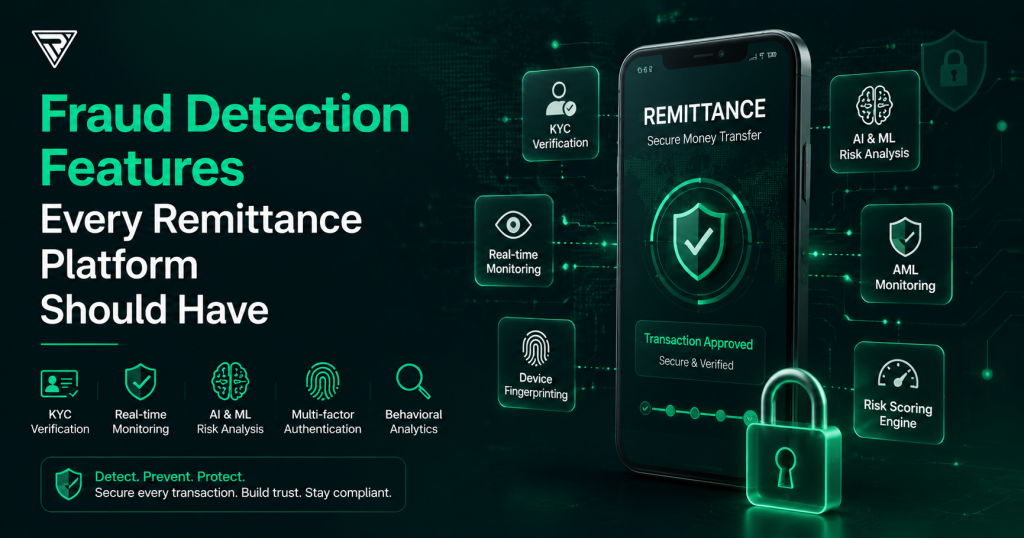
Remittance platforms have changed the way international money transfers are processed. These platforms cut the need to involve several banking intermediaries and execute the payments more quickly and affordably. Not to overlook the incredible convenience these platforms offer. They are helping millions of individuals to send funds to any part of the world from the comfort of their homes.
But with the speed, ease, and cost-effectiveness in international payments, digital remittance platforms have also created risks of identity theft, account takeovers, phishing attacks, money laundering schemes, and unauthorised transactions.
Modern remittance platforms implement a complete fraud detection ecosystem fitted with multiple technologies to protect both customer funds and business operations.
If you are a new business looking to build a secure remittance platform or improve the existing one to protect from fraud and threats, review this guide. We will go over the key fraud detection features for creating a safe and reliable money transfer ecosystem.
Importance Of Fraud Detection Systems In Modern Remittance Platforms
A remittance platform is a digital financial solution that allows individuals and businesses to send and receive money from one country to another. Due to the rise in online payments, risks associated with financial fraud and cybercrime have also increased. Thus, fraud detection has become a key security feature in every remittance platform, helping as follows:
- Automates fraud detection and removes the need for manual intervention.
- Spot and block suspicious transactions before they are processed.
- Maintains customer trust by keeping their funds and personal information completely safe.
- Comply with KYC, AML, and other regulatory requirements that remittance software ought to.
- Spot unusual activities in real time and instantly to stop fraudulent transfers.
- Reduce the risk of account takeover by identity verification and authentication.
- Create a layered defence against cyber threats.
Essential Fraud Detection Features Every Remittance Platform Should Have
A reliable remittance platform development company like Tech Remit employs multiple technologies to create a sophisticated fraud detection ecosystem. These technologies work together to identify risks before they surface, verify customer identities, and monitor suspicious activity all the time. Here’s a comprehensive list of fraud detection features that can help secure a remittance platform:
Advanced Identity Verification (KYC)
Onboarding is the first point of contact for users with the remittance platform and the easiest way to spot illicit users through Know Your Customer (KYC) verification.
Though KYC verification is necessary for regulatory compliance, it plays a major part in fraud detection as well. A Know Your Customer (KYC) verification system requires users to upload government-issued identification documents and other documents. This helps users to prove that the information they provide, such as their name, address, phone number, and email address, is correct and legitimate.
Using these digital documents, remittance software screens out users who use forged identification documents, manipulated images, or stolen identities.
Real-Time Transaction Monitoring
International money transfer platforms process payments 24/7. Thus, they need 24/7 live transaction assessment as well.
Modern remittance platforms feature real-time transaction monitoring to evaluate each transfer as it occurs. The money transfer platform would consider the transaction value, transfer frequency, payment methods, recipient history, geographic location, and previous customer behaviour, and many other risk indicators to evaluate each transaction and detect unusual activity.
Once spotted, it will flag and hold off the transaction for additional verification so that the remittance businesses can review the issue on their own.
Artificial Intelligence and Machine Learning
In 2026, artificial intelligence is almost everywhere. Well, the technology has proven to be extremely beneficial. Fraud detection is one of the many applications of AI and machine learning technologies.
Now, how they help is that these technologies detect complex fraud patterns in remittance activity by referring to historical transaction data. Not only that, these AI and ML models automatically adapt without any need for constant manual updates. They evolve by learning from newly identified threats and gradually improving detection accuracy.
Multi-Factor Authentication (MFA)
Passwords are not found safe enough to secure financial accounts. Most users stubbornly use very simple passwords, despite knowing they are putting their financial information and funds at risk.
Multi-factor authentication is a great alternative that helps improve account security. Every time users approve a transaction, they must verify their identity using a variety of authentication methods such as authenticator applications, biometric verification, hardware security keys, or push notifications, among others.
Behavioral Analytics
Behavioural analytics is one of the most advanced cybersecurity approaches that leverages user patterns to identify suspicious activity. It adds an additional layer of intelligence to power fraud detection methods.
These patterns involve the user’s login frequency, transaction amounts, preferred recipients, navigation patterns, and more.
If these behaviours differ from those of a genuine user, such as making extremely large transfers or logging in from unfamiliar devices repeatedly, the remittance platform will report them.
Anti-Money Laundering (AML) Monitoring
AML is another regulatory compliance requirement for a money remittance platform that helps avoid non-compliance issues and secures the platform as well.
Proper AML monitoring in remittance platforms can identify suspicious transaction patterns associated with criminal financial activities. The platform will create alerts whenever a user behaviour exceeds predefined risk thresholds.
Risk-Based Transaction Scoring
Not all risks are of the same severity. Some can be high, low, or somewhere in between. Modern remittance platforms, when they spot some risk, analyze it fully and flag it under the specific risk profile.
Higher-risk transactions are blocked for additional identity verification, and lower-risk transactions proceed with minimal customer friction. This balanced approach helps to maintain security and also avoid causing issues for legitimate users.
IP Address and Geolocation Intelligence
Geolocation intelligence assists remittance platforms in collecting and monitoring geographic information. Fraud detection systems in remittance platforms evaluate IP addresses, device locations, VPN usage, anonymous proxy services, and impossible travel scenarios. This provides contextual information about user behaviour and evaluates transaction legitimacy.
Device Fingerprinting
Device fingerprinting creates a unique digital identity for each device accessing the remittance platform. This technology uses browser settings, operating systems, hardware configurations, language preferences, screen resolution, and other technical characteristics to help the platform identify the device. This capability is particularly useful for detecting account takeover attempts.
End Note
With increasing fraud rates, remittance businesses must incorporate the latest fraud detection technologies to keep the platform secure, maintain compliance, and maintain business reputation.
We at Tech Remit provide world-class remittance platforms for businesses offering international money transfer services. Our white-label platforms feature high-end fraud detection systems to keep the information and funds secure. We even provide custom remittance platform development services to create a robust fraud detection ecosystem powered by real-time transaction monitoring, artificial intelligence, identity verification, behavioural analytics, and other leading technologies.
Want to learn more about how we keep our remittance software secure? Contact us today!
Recommended Read: Best Technology Stack for Remittance Software Development