How Does Remittance Software Process Cross-Border Payments?
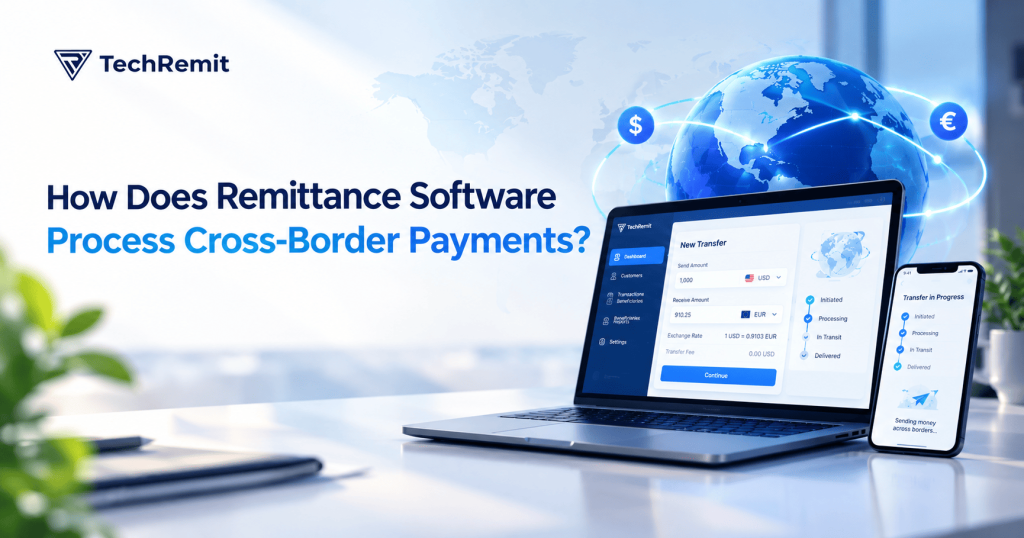
Cross-border payments involve transferring money from one country to another, often across different currencies, banking systems, payment networks, and regulatory environments. For remittance businesses, managing these transactions manually can be complex and time-consuming. This is where remittance software helps automate and coordinate the payment process.
Modern money remittance software connects customers, payment gateways, banks, compliance systems, and payout partners through a centralized platform. It can manage a transaction from the moment a customer initiates a transfer until the recipient receives the funds.
How Does Remittance Software Process Cross-Border Payments?
1. Customer Registration and KYC Verification
The process begins when a customer creates an account on the remittance platform.
The customer provides required information such as their name, contact details, identification documents, and other information required by the remittance provider.
The remittance software can integrate with KYC and identity-verification services to validate the customer’s information before allowing certain transactions to proceed.
This step helps the business establish the customer’s identity and apply its required compliance procedures.
2. Transfer Details Are Entered
After verification, the customer enters the details of the transfer.
Typically, this includes:
- Amount to be sent
- Sending country and currency
- Receiving country and currency
- Recipient information
- Recipient bank account or wallet details
- Preferred payment method
The software then validates the information and checks whether the selected transfer route and payment method are available.
3. Exchange Rate and Fees Are Calculated
For an international transfer involving currency conversion, the platform calculates the applicable exchange rate.
For example, a customer sending money in AUD to a recipient receiving EUR may see:
Sending amount ? Exchange rate ? Transfer fee ? Recipient amount
The exact calculation depends on the remittance provider’s pricing model, exchange-rate source, corridor, and payment method.
By automating this calculation, money remittance software can display the expected cost and recipient amount before the customer confirms the transaction.
4. Payment Is Initiated
Once the customer confirms the transfer, the platform initiates the payment.
A cross border payment may be funded through different methods, depending on the market and provider. These can include bank transfers, cards, digital wallets, or local payment methods.
This is where payment gateway and banking integrations become important.
The remittance platform communicates with the appropriate payment provider or financial institution to receive the customer’s funds and update the transaction status.
5. Compliance and Risk Checks
Before or during processing, the transaction may go through compliance and risk-control processes.
The software can apply business rules and integrate with external screening or compliance services to check relevant transaction and customer information.
Depending on the organization’s compliance framework, checks may involve:
- Customer risk assessment
- Transaction limits
- Sanctions screening
- AML monitoring
- Suspicious transaction rules
- Country or corridor restrictions
If a transaction requires additional review, the platform can place it into a pending or review status rather than automatically completing it.
6. Transaction Routing
Once the transaction passes the required checks, remittance software determines how the funds should move from the sender to the recipient.
A transaction can involve multiple participants, such as:
Sender ? Remittance Provider ? Payment Network/Bank ? Payout Partner ? Recipient
The exact structure varies depending on the countries, currencies, payment methods, and financial partners involved.
A flexible platform can use APIs to communicate with different banks, payment gateways, wallets, and payout providers.
7. Currency Conversion and Settlement
If the sender and recipient use different currencies, the transfer may require currency conversion.
The system records the relevant amounts, exchange rate, fees, and settlement information. Depending on the business model, currency conversion and settlement may be handled by the remittance provider, a banking partner, or another financial institution.
The software maintains transaction records throughout this process so that operations and finance teams can track the movement of funds.
8. Recipient Receives the Money
After successful processing and settlement, the funds are delivered through the selected payout method.
The recipient may receive money through:
- Bank account
- Digital wallet
- Cash pickup
- Local payment network
- Other supported payout channels
Once the payout provider confirms completion, the remittance platform updates the transaction status.
9. Real-Time Transaction Tracking
One of the major advantages of digital remittance software is transaction visibility.
A customer may be able to see statuses such as:
Initiated ? Processing ? Compliance Check ? Sent ? Completed
If something goes wrong, the system can record statuses such as failed, rejected, cancelled, or pending review.
This provides both customers and internal teams with greater visibility into the payment lifecycle.
10. Notifications and Receipts
After important transaction events, the platform can automatically send notifications.
For example, customers may receive confirmation when:
- A transfer is created
- Payment is received
- A transaction is processing
- Funds are sent
- The recipient receives the money
- A transaction fails or requires action
Notifications can be delivered through email, SMS, push notifications, or other integrated communication channels.
11. Reconciliation and Reporting
The process does not necessarily end when the recipient receives the money.
Financial teams still need to reconcile transactions with banks, payment providers, and other partners.
Money remittance software can automate reconciliation by comparing internal transaction records with settlement reports from external providers.
This can help identify discrepancies such as:
- Failed transactions
- Duplicate records
- Settlement differences
- Missing transactions
- Outstanding amounts
The platform can also generate operational, financial, and transaction reports for management and compliance teams.
A Simple Cross-Border Payment Flow
The complete process can be summarized as:
Customer Registration ? KYC Verification ? Transfer Details ? Exchange Rate & Fees ? Payment ? Compliance Checks ? Transaction Routing ? Currency Conversion ? Payout ? Confirmation ? Reconciliation
This workflow allows remittance businesses to coordinate multiple systems while maintaining a centralized record of each transaction.
Why Remittance Software Matters
Processing a cross border payment involves much more than simply moving money between two accounts. It can require customer verification, currency conversion, payment processing, compliance checks, transaction monitoring, settlement, and reconciliation.
A well-designed remittance software platform brings these processes together and can automate many repetitive tasks.
For remittance businesses, this can mean:
- More streamlined operations
- Better transaction visibility
- Easier integration with financial providers
- Automated compliance workflows
- Improved customer experience
- Scalable international payment infrastructure
As international money transfers continue to become more digital, reliable money remittance software can provide the technology foundation needed to manage increasingly complex cross-border payment operations.
Power Your Cross-Border Payments with Tech Remit
For Australian remittance businesses, fintech companies, money transfer operators, and financial service providers, having the right technology infrastructure is essential for managing international money transfers efficiently. As demand for fast, secure, and convenient cross-border payments continues to grow across Australia and global markets, businesses need a platform that can simplify complex payment operations.
Tech Remit provides advanced remittance software designed to help businesses manage digital money transfers, payment processing, customer onboarding, transaction monitoring, multi-currency operations, and other essential remittance workflows from a centralized platform.
Whether you are serving customers sending money from Australia to India, the Philippines, the UK, New Zealand, or other international destinations, Tech Remit’s technology can help businesses build a streamlined and scalable cross border payment infrastructure.