Automation in Remittance: Everything You Need to Know
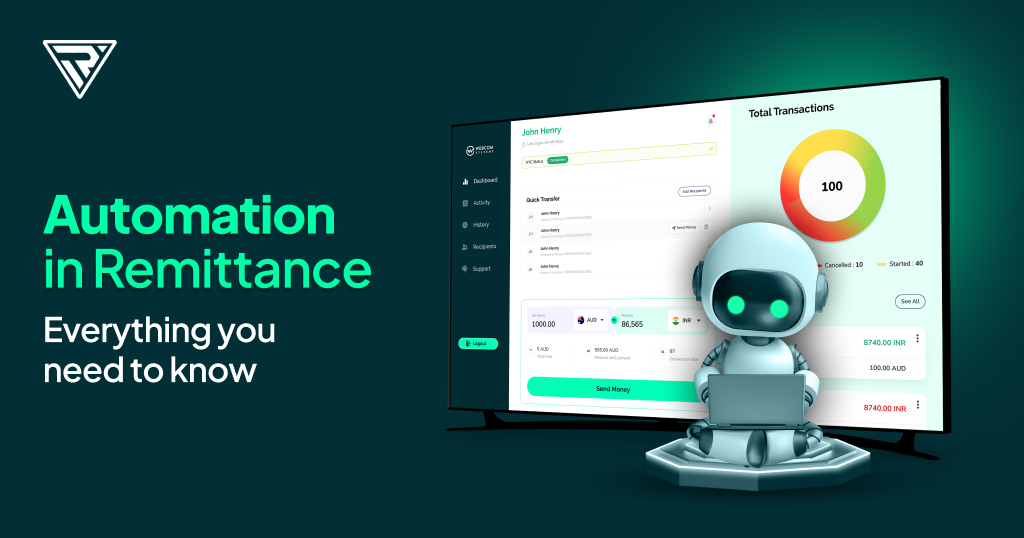
Remittance is much different from what people had to deal with a couple of decades back. From physically handing over the money, which sometimes didn’t even get past oceans to reach its rightful owner, to instant digital transfers carried through remittance apps on a smartphone, the difference is incredible.
It is made possible through remittance sector automation, which is driven by technological innovation. Automation streamlined remittance networks, thereby improving operational models for remittance businesses and, ultimately, remittance experience for customers. Whether you talk about ease, speed, security, or even the value of transferred money, everything has gotten considerably better.
To help you better understand this, this blog will go over everything you need to know about remittance automation. Read on!
Common Challenges With Traditional Remittance
Every day, millions of remittance transactions take place around the world. It is impossible to meet growing demand by processing all payments on manually managed, slow legacy platforms.
In actuality, conventional remittance systems rely on antiquated procedures that process international money transfers via extensive networks of intermediaries. Each step of the process adds more time, cost, and complexity, creating a strong need for automation, as explained below:
- Manually operated remittance businesses require physical infrastructure, a workforce, and training. These resources increase both operating costs and remittance fees.
- Cross-border financial transactions must comply with numerous local and international legal requirements, including KYC, AML, and other regulations. These guidelines are extremely difficult to follow and ensure transaction compliance.
- Each network participant performs manual checks to validate the transaction. This frustrates remitters and reduces transaction speeds.
- The traditional payment settlement system is only available on weekdays and during regular banking hours. This limits flexibility and creates delays in cross-border transactions.
- Every participant in the long remittance chain charges a service fee. This significantly raises the total cost of sending money across borders.
Understanding Automation In Remittance
Automation in remittance involves the use of advanced technological infrastructure to manage cross-border money transfers. These platforms are powered by the leading technologies and tools to handle the complete remittance transaction. Thus, they handle tasks that were previously managed manually, such as
- Verifying the details of the sender and the receiver
- Complying with Know Your Customer (KYC) and Anti-Money Laundering (AML) regulations
- Processing payment instructions across multiple currencies and countries
- Generate transaction reports and reconciliation data.
- Analysing and maintaining the security of transactions
How Do Automated Remittance Platforms Operate?
From the point the sender initiates the transfer request to the funds reaching the receiver across borders, here’s how remittance transactions are processed:
- Users sign in on the platform by filling in their details and providing the necessary documents to verify their identity.
- Remittance software analyzes the documents and verifies the user to create their account.
- Once verified, the user enters the transfer amount, provides the details of the recipient, and chooses the preferred delivery method.
- The platform automatically performs AML and KYC checks and validates transaction details.
- Users get calculated live exchange rates and transfer fees for their transfer.
- As soon as the user pays the amount, the system routes the transaction through optimized payment channels.
- The remittance software will coordinate with payout partners, banks, or mobile wallets to release the funds securely.
- Both sender and receiver receive real-time notifications of transfer status, and they can even check through the tracking feature on the platform.
- Finally, the funds are delivered to the intended recipient.
Key Benefits of Automation in Remittance
The goal of automation in remittance software is to eliminate the need for human intervention, speed up processing, lower operational costs, and improve customer experience.
Faster Transaction Processing
Automation has helped in increasing the speed of remittance transactions. All the operations, whether user verification, currency conversions, or payouts, are processed by the automated platforms, and that too in real time.
This is beneficial to remitters who want to send money across borders immediately for urgent payments such as medical expenses or family emergency support.
Reduced Operational Costs
Remittance service providers can carry out their tasks, like data entry, compliance verification, and reporting, without manual labor or paperwork. This reduces operational costs for remittance businesses and hence lowers transfer fees for customers.
Enhanced Accuracy
Errors are common in manual operations. This frequently results in transactions, improper payments, or noncompliance with regulations.
However, the automation provided by remittance software helps to eliminate this issue. The software program is equipped with all of the necessary tools and technologies to accurately execute the remittance process and handle all payments. The chances of error are next to negligible with operations powered by these platforms.
Improved Compliance
Automated remittance systems are designed to comply with any set of regulatory frameworks. They check for violations, flag suspicious activity, and create audit-ready reports.
Better Customer Experience
Automation in cross-border transactions directly impacts the customer experience. They benefit from the speed, security, and ease offered by mobile remittance platforms. Moreover, users can also check the status of their transfers, receive alerts about potential issues, and get faster resolutions to their queries.
Emerging Technologies Driving Automation in the Remittance Industry
Modern remittance platforms are equipped with the following platforms that assist in automating remittance processes as follows:
- Artificial intelligence (AI) technology can detect and flag suspicious transaction patterns in real time. Thus, they assist in avoiding noncompliance and strengthening transaction security. Beyond this, AI systems can also predict currency fluctuations based on past deviations and optimize payment routing.
- Blockchain technology keeps a record of all the transactions and maintains transparency in cross-border transfers. Smart contract-based transactions take automation to another level by completely eliminating the need for human intervention. They transfer assets automatically once the predefined conditions are met.
- Robotic Process Automation (RPA) employs software “robots” to complete repetitive tasks like data entry, verification, and reconciliation. This allows for the automation of key operational processes, including KYC checks and bulk payment handling, and much more.
Conclusion
Automation has completely transformed the way the remittance industry works. Once so so-called major challenges such as transfer delays, high fees, regulatory compliance burdens, and operational inefficiencies have been largely eliminated by automated remittance platforms.
We at Tech Remit are empowering remittance transactions with our powerful remittance platforms. Fitted with all the leading technologies, our white-label money remittance software offers secure and real-time cross-border transactions to almost every part of the world.
From automated transaction processing to AI-driven risk management and more, our platform streamlines the remittance processes and handles even the most complex international transfers. Get in touch to discuss more.
Also Read : How to Tackle the Top Remittance Problems in Banking ?