Best Technology Stack for Remittance Software Development
In 2026, remittance software is powering the global cross-border payments ecosystem. These platforms simplify the payment experience for individuals and businesses and handle all the intricacies of processing international money transfers behind the scenes.
With the global remittance market expected to grow from USD 212.43 billion in 2026 to USD 381.98 billion by 2031, it presents a lucrative business opportunity for enterprises to launch their own platform.
But building these sophisticated platforms requires a powerful tech stack to support platform development and growth as well. Read this guide to know the best technology stack to engineer premium remittance software for your enterprise.
What Is A Remittance Software Tech Stack?
A remittance software tech stack represents the complete set of tools and technologies used to build the international money transfer platform that serves individuals, businesses, and financial institutions. These usually include a combination of various programming languages, frameworks, and software tools that support the development and operations of the platform’s technical infrastructure.
Why Choosing the Right Technology Stack Matters
As we already discussed what a tech stack is, why is this decision still so important when building remittance software?
For starters, the remittance market is one of the most dynamic markets dispersed globally. Thus, remittance software needs to operate in the most demanding environments when processing international payments. While doing so, platforms need to maintain high standards of security, speed, and privacy, as well as comply with all international money transfer regulations.
This places a great deal of responsibility and accountability on these payment systems, and even a single error can result in the loss of reputation, businesses, user funds, or sensitive data. Not to mention that even minor violations can result in costly penalties and even business closure.
Thus, the technology stack supporting the platform infrastructure should be able to empower the remittance software in smoothly handling peak transaction volumes and integrating with external financial institutions without affecting speed, security, or compliance.
Every architectural choice, from front-end frameworks and back-end services to databases, cloud infrastructure, and security controls, would together impact the platform’s quality and customer experience.
The Top Technology Stack for Remittance Software Development [2026 Edition]
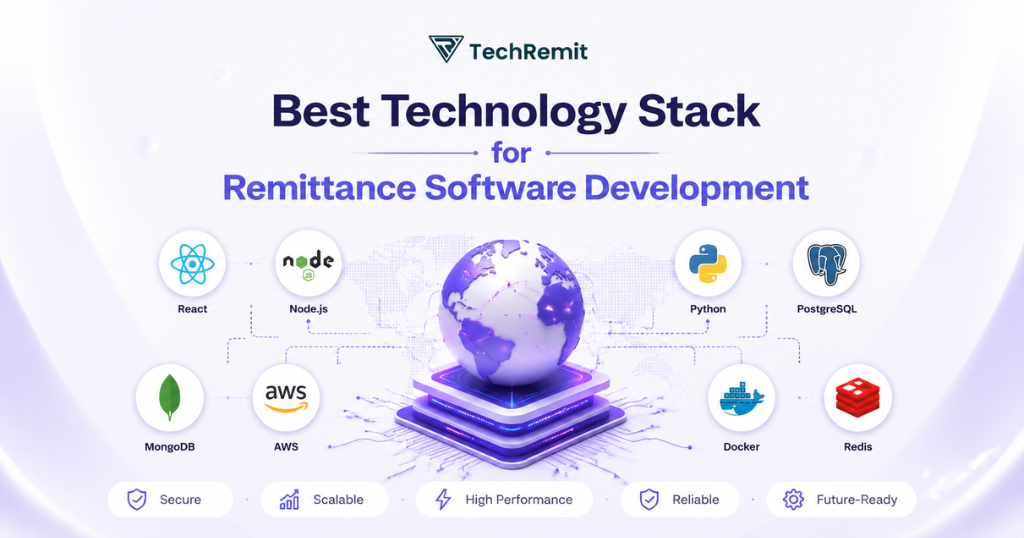
The tech stack for remittance software development can be divided into front-end, back-end, database, cloud infrastructure, DevOps, and security categories. Here is the complete list of all:
Frontend Technologies
The frontend is the user-facing part of your remittance software. It is designed to deliver a responsive experience across web and mobile devices. It covers the user journey and displays live data such as exchange rates, transaction statuses, beneficiary information, and payment history. Here are some of the common technologies employed for front-end development:
React.js
React.js is an open-source JavaScript library often used in developing the interactive UI of remittance applications. React.js’s component-based architecture makes it easier to manage complex financial interfaces.
Angular
Angular is a full-featured framework designed for large enterprises that require a structured architecture to support large-scale fintech platforms. It helps in the integration of front-end and back-end components. Angular is chosen for its built-in dependency injection, routing, and reactive programming support the building administrative dashboards and transaction monitoring systems.
Vue.js
Vue.js is a progressive JavaScript framework that helps in building high-performing user interfaces. It is also very simple to work with and integrate.
Flutter
Remittance platforms are primarily customer-facing applications. That’s why most money transfer companies use Flutter to create Android and iOS apps from a single codebase. This helps lower development and maintenance costs.
Backend Technologies
The back end is the server-side component of the remittance software that handles platform complexities in the background. Thus, it deals with customer onboarding, KYC verification, exchange rate calculations, compliance checks, payment processing, and even collaboration with external banking systems, all through the remittance software. Explore the different backend technologies that are commonly used in remittance platform development:
Node.js
Node.js is a cross-platform JavaScript runtime environment that features a non-blocking I/O model. It is one of the most popular backend technologies for remittance software development, as its event-driven architecture can smoothly handle high volumes of API requests.
Java
Java is preferable for developing enterprise banking applications that power production-grade infrastructure due to its stability and mature ecosystem.
Python
Python is employed along with the primary backend services in remittance platforms to support fraud detection, operational automation, data analysis, transaction monitoring, and machine learning.
Database Technologies
Every fintech platform relies on large databases to manage consistent transactions and provide quick access to this data as needed. Here are some of the databases used in the remittance platforms:
PostgreSQL
PostgreSQL is one of the most reliable databases for remittance platforms, as it features an ACID-compliant transaction engine and delivers JSONB support and logical replication capabilities. It processes payments quite accurately even during high transaction volume.
Redis
Redis is an open-source and in-memory data structure that perfectly complements PostgreSQL. It caches exchange rates, authentication sessions, and frequently accessed customer data.
MongoDB
MongoDB is frequently used to store unstructured data that does not require a traditional relational schema, such as application logs, notification histories, fraud investigation records, and more.
Security Technologies
Security is integrated throughout the application architecture to keep the platform safe from any attacks and threats. Authentication between a client and a server can typically be integrated using OAuth 2.0, OpenID Connect, and JWT to enable multi-factor authentication (MFA). Furthermore, TLS 1.3 can carry data encryption during transmission, and AES-256 when stored in databases or cloud storage.
Cloud Infrastructure and DevOps
Remittance platforms are deployed on cloud-native infrastructure using Amazon Web Services (AWS), Microsoft Azure, or Google Cloud Platform (GCP). AWS is a popular choice as it provides managed services such as Amazon EC2, Amazon RDS, Amazon S3, and AWS Lambda for hosting applications, databases, document storage, and serverless processing.
Further, containerization can be implemented using Docker, while Kubernetes can manage container orchestration to automate deployment, scaling, and workload management. At Tech Remit, we frequently use GitHub Actions, GitLab CI/CD, and Jenkins to implement CI/CD pipelines and reduce common deployment bottlenecks.
How to Choose Tech Stack for Your Remittance Software?
Even the most powerful technology cannot be the best fit for your remittance solution. Here’s how you can select the technology stack to create a structural remittance software foundation that makes everything work:
- Make development speed a top priority. React, Angular, and Vue.js simplify UI development, while Node.js and Java handle backend development.
- Choose a stack that supports platform growth instead of becoming the biggest hindrance. It can save you from rebuilding your entire system in the future.
- International payments thrive on speed, and this is what gives that competitive edge to any remittance business. Therefore, choose technologies that provide real-time responsiveness on all devices and speed up page loading.
- Keep in mind that the best tech stack not only simplifies development, but also allows for easy maintenance without adding complexity.
Wrapping Up
To summarize, not just a single programming language or framework, a remittance platform needs a specialized set of technologies for the front end, back end, databases, cloud infrastructure, security, and DevOps. Selecting the right technologies from the outset can help improve business efficiency and even avoid technical redevelopments.
At Tech Remit, we specialize in developing secure and feature-rich remittance software designed to meet the business requirements of fintech startups, money transfer operators, and payment service providers. We provide white-label remittance solutions built using the latest tools, technologies, and frameworks to power secure and compliant platform infrastructure.
Besides, we also offer custom cross-border payment solution development services to build platforms as per your business requirements. Whether you’re launching a new remittance solution or upgrading a current platform, we have the expertise to deliver a future-ready product. Get in touch to discuss your project!
Recommended Read: API Integrations Every Remittance Software Needs: A Complete Guide