Step-by-Step Guide to Launching a Cross-Border Payment Platform
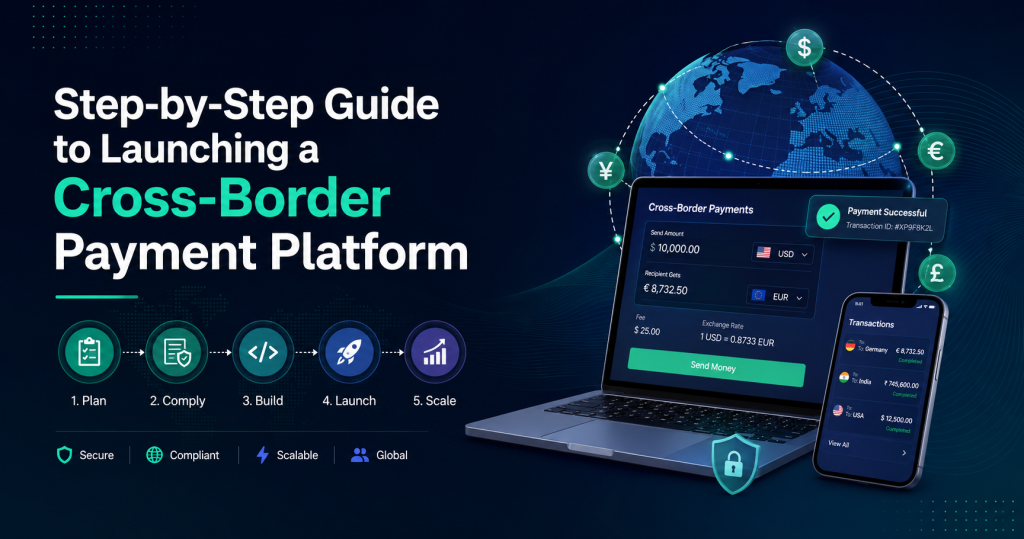
The global cross-border payments industry is growing rapidly. This market was worth approximately $187.7 billion in 2025 and is expected to reach $312.1 billion by 2033. It clearly creates an excellent opportunity for businesses to capitalise on this thriving market by providing international money transfer services.
Moreover, banks no longer dominate cross-border payments the way they once did. Nowadays, migrant workers, as well as businesses, count on remittance platforms and digital payment providers to send money overseas to families, suppliers, vendors, and service providers. These platforms make international transfers faster, more affordable, and, of course, convenient.
If you’re planning to launch a remittance platform for your remittance business, understanding what it actually takes to enter the market is essential. In this guide, we’ll walk you through the step-by-step process of launching an international payment platform. Let’s first discuss what a cross-border payment platform is.
What Is a Cross-Border Payment Platform?
A cross-border payment platform is a payment system that allows individuals as well as businesses to send money from one country to another. It handles everything from payment collection to currency conversion and payment to the overseas recipient.
To understand how this works, take an example where an individual in Australia wants to send money to their family in New Zealand.
When the sender creates the transfer request, the platform accepts the payment, processes the transfer, converts the currency, deducts the fee and delivers the amount to the recipient through a bank account, wallet, or cash pickup partner.
So, this is how these payment platforms basically operate. Clearly, a money transfer business acts as an intermediary between the sender and the recipient, offering payment services through its cross-border payment platform. They can use different payment methods to incorporate into the money transfer business, such as traditional banking rails, local payout partners, card networks, digital wallets, or even blockchain-based rails in some cases.
How To Launch A Cross-Border Payment Platform
Traditional payment money transfer services involve multiple intermediaries, slow settlement, hidden fees, and limited tracking. Digital-first payment platforms improve this experience by offering anytime, anywhere accessibility, fast money transfers, better transparency in cost and tracking of payment, and more payout options.
Thus, more and more individuals as well as businesses are switching to these platforms in 2026. But launching a cross-border payment platform is not as simple as just launching any other mobile application or web app. These systems manage global regulations and the complexities of international payments, which require a structured approach for launching the platform.
Here’s how you should handle the entire process of launching your own platform:
Define the Exact Business Model
First and foremost, be specific about the type of service you want to provide. So, what that means is asking different questions and getting clarity on the following:
- What kind of customer base do you want to target, whether it’s business, migrants, or both?
- Do you want to build an app or simply a web platform?
This would be the starting point, which would set the course of your whole money transfer business. Discuss these options with your team.
Choose Your Target Corridors
Now comes the point of choosing the payment corridors for which your platform would offer money transfer services. You can go for global payments, but when just starting out, it is preferred to choose a select number of corridors. Each route would present different regulations and require special considerations for customer behaviour, payout options, and compliance risks.
Your businesses can, however, opt for high-potential corridors in the operational country. For example, a business operating in Australia can target Australia to India, Australia to Nepal, and related corridors.
When making these decisions, consider transfer demand, regulations, banking and payout options, average cost of sending money, and other factors for each corridor and aim to make the service manageable.
Decide Between White-label and Custom Development
Now comes building the platform; for that, you have two options. You can either choose white-label software or go for custom development.
A white-label solution is a ready-made payment or remittance platform that comes with complete platform capabilities to provide international money transfer services. You can shorten development time, reduce technical costs, and even customise core payment features. This option is best for startups entering with specific corridors first.
Custom development means building the platform from the start as per your own business requirements. It covers everything from user flows, integrations, compliance logic, and payout models to platform architecture, admin panel development, API integrations, transaction engine setup, reporting and reconciliation, and scalability planning.
Although this approach provides greater flexibility in functionality, it requires a significant amount of time and money to launch the platform.
Therefore, you can
- Choose white-label if you prefer a lower upfront cost and a faster launch.
- Choose custom development if you are looking for flexibility and long-term control.
However, no matter the approach you pick, you should always choose a reliable fintech software development company like Tech Remit to build the technical infrastructure for your business.
Decide Payment Flows for Your Platform
Along with the corridor, you will need to define the payment flow for your platform. This means choosing the payment methods you want your platform to support. You can choose options like the following:
- bank transfer,
- debit or credit card,
- mobile wallet,
- cash through an agent network,
- or, in some cases, crypto.
Along with the payment option, you need to pick a payout option as well. Depending on the markets you serve, payout methods may include:
- bank account transfer,
- mobile wallet payout,
- cash pickup,
- card payout,
- or local account credit
You can select a single option or a combination of these options, depending on the preferences of your target customer base and the complexity of the options that you find more manageable.
Establish Banking and Payout Partnerships
You must collaborate with banks, payment processors, local payout providers, mobile wallet operators, or cash pickup networks, depending on the platform’s chosen payment methods.
These services would handle fund collection and recipient payouts across your target corridors. Just make sure you choose reliable partners, as this will have a direct impact on your customer service.
Design a Simple Customer Journey
Whether you opt for a white-label or custom approach, your platform should feature a user-friendly interface. The customer would be able to go through the following simple steps to use the platform:
- Download the application to sign up and complete verification
- Choose the payment corridor and enter the amount to send
- View fees, exchange rate, and expected delivery time
- Provide recipient details and pay for the transfer
- Easily tracks the payment until it is delivered
Whether the user is sending money home, paying an educational fee, covering emergency payments, or conducting a business transaction, the payment experience should be simple.
Understand the Regulatory and Licensing Requirements
International money transfer is a regulated financial service. So, before launch, you need to secure a money transfer or payment services licence.
The regulations governing these financial transactions can vary significantly from one country to another. As a result, you must ensure that your platform complies with KYC and AML regulations, as well as other reporting obligations, in the countries to which it will be deployed.
A compliant platform typically includes customer identity verification, transaction monitoring, sanctions and watchlist screening, fraud detection controls, and a process for handling compliance alerts. So, aim to incorporate these features in your platform as well.
Licensing and regulations are indeed some of the trickiest, but they are the most important aspects of launching a remittance platform. They help in gaining customer trust and also lowering the risk of AML concerns and other legal or regulatory issues.
Build a Transparent Pricing Model
Affordability is one of the biggest reasons people switch money transfer providers. So, the fee structure that you feature on your platform should be reasonable, transparent and free from any hidden fees.
A strong pricing model clearly shows:
- the transfer fee,
- the exchange rate,
- and the final amount the recipient will get.
You can aim to provide competitive exchange rates and a low transfer fee to offer reliable services in the market
Launch and Expand Gradually
Once the platform is ready to launch, begin by evaluating it in one or two strong markets to ensure that the product works properly, and then gradually expand.
You can test user onboarding, analyse customer conversion rates, and gather customer feedback to improve support and pricing.
Launch Your Cross-Border Payment Platform With Tech Remit!
Launching a crypto payment platform is not engineering software. It requires taking care of a lot of things, from understanding the regulations to building technical infrastructure incorporating every required component, securing licensing, and much more, to deliver a financial service that customers can trust eventually.
Hence, it is better to rely on tech experts who can help you launch a feature-rich remittance platform that meets industry standards, user expectations, and compliance requirements. At Tech Remit, we assist scaling startups and established enterprises in launching their global payments solutions.
We offer white-label remittance platforms to help your business enter the market quickly and even within a reasonable budget. Our team will configure the platform to meet your functionality requirements, and you will be able to launch the entire payment system using your brand name and logo.
Not only that, but also if you want to build a custom platform completely from scratch. Our team can assist you every step of the way, from selecting the right business model to creating a smooth transfer flow, establishing reliable payouts, complying with regulations, pricing transparently, and using modern technologies in a way that actually improves the remittance experience.
Contact us today to discover more about Tech Remit’s cross-border payment solutions and launch your own platform!
Recommended Read: AI Improve Remittance Software Development